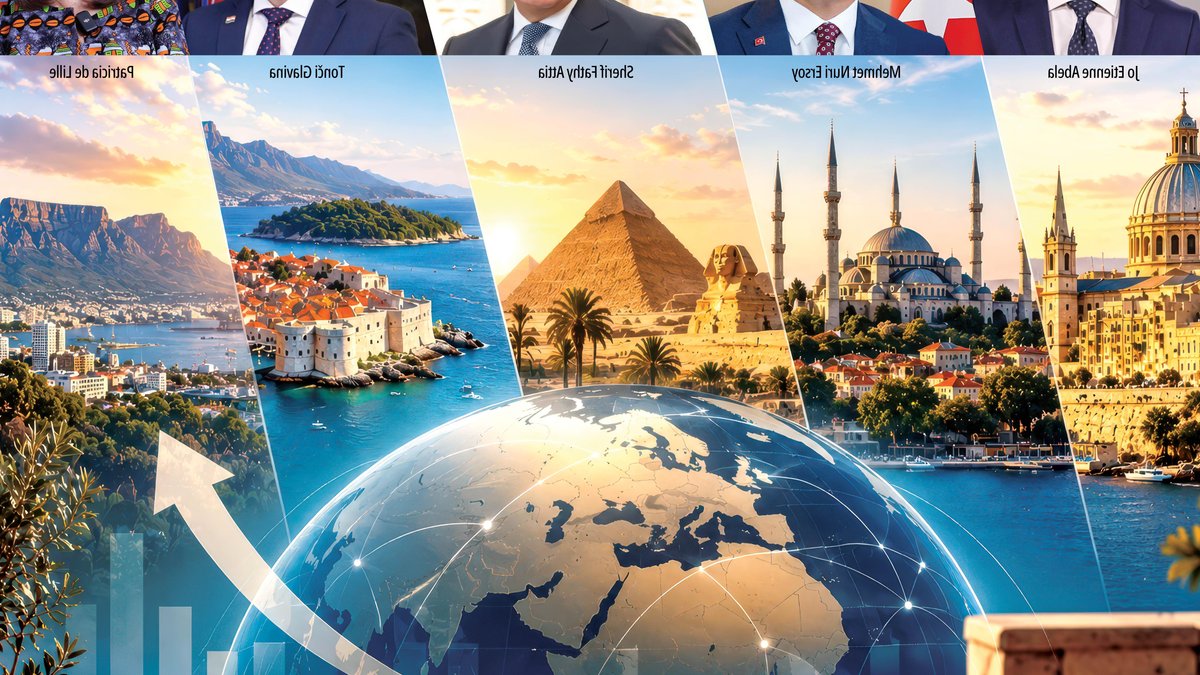
The focus of discussions around tourism has moved away from simply tracking visitor numbers and instead centers on determining what kind of growth benefits destinations most effectively. During a recent gathering, tourism ministers from Malta, Croatia, Egypt, Turkiye, and South Africa examined how to reconcile economic gains with the needs of local communities and environmental preservation.
Historically, tourism progress was evaluated based on metrics such as visitor counts, hotel occupancy rates, and foreign currency earnings. However, as destinations grapple with infrastructure challenges, uneven visitor distribution, and environmental pressures, the discussion has shifted toward whether growth should emphasize quantity or quality. The ministers concluded that effective collaboration between public and private sectors—not just attracting more tourists—is essential for sustainable development. They stressed that governments, businesses, and local communities must share responsibility for long-term success.
The forum, led by Richard Quest of CNN Business, moved past general calls for cooperation to tackle specific policy decisions. Tourism cannot succeed in isolation from broader sectors like transportation, finance, environmental management, or urban planning. The ministers presented varied strategies: Egypt and Turkiye prioritized increasing visitor numbers by developing new attractions, while Croatia focused on higher-value tourism and stricter capacity limits. Malta faced challenges in balancing a thriving tourism economy with maintaining residents’ quality of life, whereas South Africa aimed to improve transportation links and shift perceptions of its tourism industry.
Tourism as a core economic driver
A key point of agreement was the necessity of treating tourism as a core economic driver rather than a secondary concern. Patricia de Lille, South Africa’s tourism minister, described the need for persistent advocacy. Tourism accounts for 4.9% of GDP and sustains nearly one million jobs, yet policymakers often favor manufacturing or industrialization over its broader economic contributions. She emphasized that tourism functions as both a public benefit and a tool for shaping national identity through positive visitor experiences. For South Africa, the U.S. has become the fastest-growing source of tourists, and recent expansions in air routes reflect efforts to strengthen connectivity—a factor frequently overlooked in tourism planning.
Turkiye’s strategy presents a different model. In 2018, the government designated tourism as a key economic sector, aligning policies across ministries and appointing a private-sector executive to lead the ministry. Mehmet Nuri Ersoy, the culture and tourism minister, noted that tourism activity had expanded beyond major cities to all 81 provinces, with growing investment interest in new regions. However, the country acknowledges limitations: while it hosted 64 million visitors last year, officials aim for 100 million but only if new destinations can accommodate growth without overburdening infrastructure.
Croatia’s approach diverges significantly. Tonči Glavina, the tourism minister, rejected the assumption that more visitors automatically lead to better outcomes. Instead, Croatia has established legal limits on visitor numbers during peak seasons, using studies on carrying capacity to assess constraints such as energy use, waste management, and traffic congestion. The objective is to distribute tourism benefits throughout the year rather than concentrating them in crowded summer months.
Croatia’s strict visitor limits and sustainability plans
Croatia’s strategy includes mandatory destination plans that track visitor satisfaction, allowing adjustments based on local requirements. The approach shows that sustainability is not a fixed endpoint but an ongoing effort to balance economic gains with community well-being.
Egypt’s minister warned that additional taxes create an unwelcoming impression, potentially harming competitiveness. South Africa’s de Lille cited her efforts to reduce a proposed $500 visa fee to under $20, positioning visa accessibility as a competitive edge. Jo Etienne Abela, Malta’s minister, defended the country’s €1.50-per-night eco-tax, stressing transparency and ensuring visitors understand the purpose and benefits of the charge.
Turkiye adopted a contrasting approach by reducing its accommodation tax from 2% to 1%, effective May 1, 2026. This adjustment aligns with broader efforts to balance revenue collection with growth objectives. Ersoy highlighted that sustainability requires enforceable measures, such as Turkiye’s 70–80% reduction in tourism rentals to stabilize housing costs or mandatory certification for hotels under a Global Sustainable Tourism Council framework.
Malta’s all-government tourism tax and shared assets
Malta’s tourism sector contributes roughly 17% of national GDP, prompting officials to treat tourism as an all-government enterprise. Roads, airports, public transport, utilities, waste management and urban services are classified as shared assets rather than solely tourism infrastructure. A tourism tax now applies to licensed hotels, guesthouses, apartments, host families and other commercial accommodations across Malta and Gozo, with the Tourism Ministry consulted before any rate changes to safeguard sector growth.
Egypt aims to triple current visitor numbers before overtourism becomes a concern, relying on diversified experiences, targeted marketing, tour-operator engagement and future artificial-intelligence tools. Turkey also identifies considerable expansion potential while monitoring capacity limits. Governments are tasked with spotting infrastructure gaps, streamlining approvals, providing policy certainty and establishing destination-management frameworks; businesses contribute capital, operational expertise, distribution networks and insight into evolving traveller demand. Even isolated incidents of problematic visitor behaviour can spark public alarm, so authorities emphasize listening to residents, monitoring conditions and enforcing rules proactively. Cooperation among destinations, businesses and governments is presented as a way to distribute demand, allowing travellers to explore a broader range of locations without overburdening any single site.


